Showing posts with label New Towns. Show all posts

Tuesday, 11 April 2017

The State of France


Last summer I attempted to fulfil a long-held ambition: to travel down the Loire valley in France from its source to the sea.  The journey began at Le Havre which provided an excellent opportunity to see the most comprehensive  collection of buildings by Auguste Perret in France or indeed the world. Le Havre is a city whose centre was almost entirely destroyed by war  in 1944; the responsibility for reconstruction was basically the responsibility of one architect, Auguste Perret.


The whole centre has strongly formal Neo-Classical quality, based as it is around  axis and squares. This Neo-Classical approach extends from both the urban design strategy to the individual buildings. When Le Corbusier came to design the great sequence of spaces that form the entrance to the Capitol complex at Chandigarh he apparently based many of the proportions on the Rue de Rivoli in Paris.  In Le Havre  Perret  draws on a different architectural precedent, in this case, it would seem, the Parisian apartment block. The proportions are not reproduced exactly; there are nods in the direction of modernity, the  buildings shoot up from the bench-mark average of around four stories to mini-Rockefeller Centre proportions. Perhaps the greatest difference here is one of materials, the buildings here are not constructed of stone but of reinforced concrete.

Walking around the centre of  Le Havre  I felt that Perret and his team had avoided the  monotony often associated with system buildings of the 1960’s. Perret and his team seem to have found different ways of detailing concrete ensuring that, though there is a degree of unity, there is sufficient variety too. It is possible to argue that the ultimate uniformity comes from repetition of the  window unit. Christian Norberg-Schulz  argues that the proportions of French windows were determined by the quality of French light, something felt to be unique, from the age of stained glass to the time of the Impressionists. The proportions of the classical French window ensure that the window reaches down to the floor. The  balcony frontage ensures  “inhabitants can participate in the life of the street below”, indicating that “mixed-use” was once a natural component of the French city.


There are several sites within the city with a claim to the city’s  Stadtkrowne or city crown , such as the  Oscar Niemeyer buildings or centre of municipal government, Hotel de Ville. The Church of Saint Joseph by Perrett is for me my nomination for  candidate for this title. As an ecclesiastical architect, Perret tends to be remembered  for buildings such as Notre Dame du Raincy, often viewed as a sort of reinterpretation of a Gothic idiom. This attitude was always simplistic, stylistic and shallow. In that building he employed vaulting techniques in innovative ways even if the stained glass seemed to owe something to precedent. At St Joseph in Le Havre, he allows his modernist instincts a much freer reign. It  side steps any attempt to reproduce the spatial qualities of France’s medieval cathedrals. If you are looking for a historical precedent perhaps the centralised, Greek cross plan is a relevant example here or the Adolf Loos design for the   Chicago Tribune building. Quite unprecedented is the  single unified space at the centre of the building,  a column of light extending some  84m into the air. Highly impressive are the concrete finishes, detailing and structure such as the cross-bracing to the tower. Concrete as a material with architectural potential occasionally comes back into fashion.  Here Perret’s  building sets   exemplary standards which are still relevant today.


                                                                          St Joseph by Perret

The rectilinear architecture which makes up most of the centre of Le Havre, of course, seems highly fashionable today. More surprising is the evident success of the centre, devoid of the stigma of social failure often associated with  high-density  housing and “New Towns”. Although you can  argue how successful the French New Towns program has been, Le Havre  certainly seemed a great improvement  on many British new towns and does not require the sort of regeneration currently being undertaken in  Bracknell.

Travelling through France, by car if not by train, it is surprising to what extent out-of-town retail parks have been given the “green light”  by French authorities.  Again and again, I came across towns whose outskirts consisted of large retail parks, developments which would make Las Vegas look like a model of restraint and elegance.  This is certainly not the case in Holland where retail is usually integrated into mixed-use developments. When I arrived at Tours I stayed in a hotel in  a huge retail development, with the small consolation of a tram line that would take me into the town centre. Public space is generally well designed in France so perhaps they need to re-invent the notion of mixed-use.

The French are not exactly famous for an addiction to suburbia so how exactly has the vitality of French town centres seeped away?  An interesting article appeared on this subject in The New York Times   where it seems that the decline of provincial towns has reached the level of a  malaise.


The route I traversed passed by many key sites  of Gothic architecture. The theorist seeking a guide to these buildings  can turn to many sources; Ruskin was often considered to be the essential source of authority on this subject, though, in fact, he had some very strange views on the subject. He regarded Venice as the essential home of Gothic architecture when, in fact, it originated in France. Venice and Britain were regarded as nations with parallel destinies; one  the home of a once-great  maritime empire, the other  Britain when its own empire  was at its height. Many of his writings  should be regarded as poetic interpretations of architecture and, in that sense, they excel. Another potential theoretical source might be Pugin though he  tended to see everything in terms of religious fundamentalism.   For a rational, technical, Cartesian interpreter of Gothic a   better guide  to Gothic  would be Viollet-le-Duc.

Viollet-le-Duc had an upbringing rather typical of his time; anti-clerical, secular, republican. He became one of the chief figures of the Gothic revival in 19th Century Europe. His success as a restorer of Gothic architecture was cemented by the commission to restore   Notre Dame Cathedral in Paris; the support of Victor Hugo, the author of the novel “Notre Dame de Paris” , was crucial in obtaining this commission.         


The period of Gothic architecture can be rightly seen as one of the most innovative periods in the entire history of architecture, a period made possible by two technical innovations, the pointed arch and the flying buttress. Roman (and Romanesque) Architecture utilised semi-circular arches, which because they usually rise to the same height, usually imply square bays. With pointed arches, however, by varying the steepness of the angle of the arches or ribs it was possible to achieve rectangular bays or indeed rhomboidal or polygonal shaped structures. Gothic Architecture was thus able to achieve a level of spatial complexity not previously achieved by Roman and Romanesque Architecture.  The flying buttress was also a technical innovation of equal importance. Buttresses had been used before, for example, in large works of Roman architecture such as thermae and basilicas. Buttresses of this type had been built at regular intervals along walls whose top consisted of the springing for groin or barrel vaulting. Their mass helped to resist the spreading movement of the vaulting above. The innovation that Gothic architecture made was to separate the buttress from the building, joining it with an arch. This made large clerestory windows possible and removed shadow-casting buttresses instead flooding the interiors with natural light.

Viollet-le-Duc  argues that many of the features of Gothic architecture were generated by the nature of the construction process in France in the 12th and 13th Centuries. Stone was the natural material to use as  quarries were plentiful. Stone was an expensive material which had to be used economically hence it had to be used in an efficient way. Features such as ribs in the vaulting had been generated by the needs of the construction process. The ribs had been erected first on timber centering; the shell infill added later without the need for more centering (Viollet-le-Duc argues unconvincingly that this was necessary due to timber shortages).

He finds a functional justification for every aspect of the finished design. The ribs in the vaulting act, for instance, act as reinforcement to what is basically a groin vault. In a typical Gothic cathedral the buttress is separated from the main building by an arch, partly to let more light in through the clerestory and partly to allow people move around the outside to clean the windows. The buttress is surmounted by a large mass of stone in order to weigh the buttress down and prevent it from overturning. The opening between the arcade and clerestory, known as the triforium, is there to help lighten the structure. All the mouldings have a functional justification too. Externally they throw off rain-water; internally they act as footings to vaulting or corbels to indicate level. Viollet-le-Duc is not opposed to ornament but believes it is secondary.  All ornament is based on local flora or  an enrichment, never  a distortion, of the essential structure.

Most of Viollet-le-Duc’s theories about the functionality of Gothic architecture are to some extent rational and to some extent hypothetical; a more genuinely scientific answer to these questions might be found  in the writings of the American  academic, Robert Mark.
When one reads a writer like Christopher Alexander, it becomes clear that it is something of a myth that the origins of Gothic architecture lie in the work of Abbot Suger at the cathedral of St-Denis. The reality is rather more complicated. I recall my surprise, many years ago, at seeing pointed arches in Durham Cathedral in what is clearly a Romanesque building. Alexander  states that these arches were built between 1120 and 1133.  The West front and Choir  of the Abbey of St. Dennis were begun  in 1140 , followed shortly after by the commencement of construction on the Cathedral of Notre Dame between  1150 and 1155.

The first major Gothic building   I visited was the cathedral of Chartres. With its vertical quality and green roof it appears like a great ship sailing across rural France, dominating the surrounding countryside. One of its most initially arresting qualities is the asymmetrical towers. Their disparity can be explained by their construction dates. The rebuilt north tower was finished in 1514, whereas the south tower was finished in 1155. The latter was built  at a time when the new architecture was ridding itself of the last vestiges of Romanesque  influence whereas the influence of Flamboyant tracery was at its peak  when the north tower was completed. 


                                                                         Cathedral of Chartres


In addition to its tectonic qualities, Chartres is a triumph of decorative art. It has the most admired stained-glass of any cathedral in France. Almost equally admired is the stunning sculptures on its west, north and south portals.
When I arrived the building was surrounded by French soldiers, a reflection of the state of emergency the French government had placed the country under. I was not even allowed to take a penknife inside. However,  I was able to walk round the outside, admiring  the flying buttresses. The roof is covered by quadripartite vaulting, i.e. a single bay of what is basically a pointed groin vault covers one bay of the arcade.


From Chartres I went onto Le Mans to visit the cathedral, almost  the only outstanding piece of architecture I saw in a very disappointing town. I paused to admire the  flying buttresses, one of the most impressive examples of this kind of tectonic form along with Beauvais and then travelled onwards to Bourges.


                                                                        Cathedral of Le Mans


The Cathedral of Bourges provides much food for thought regarding the development of Gothic. Rather like the Cathedral of Wells, the west facade    is dominated by two towers,  albeit that in this example, the main feature  seems to a rather curious lozenge-shaped window.  The interior, despite the fact that it has no transept , is one of the most extraordinary of any French Gothic cathedral. The building has double aisles, unlike Chartres where these occur only at the ambulatory towards the east end. The clerestory windows are much smaller. The overall vaulting feels much more spacious, the sense of rhythm, regarding the spaces and the way in which they progress towards the east end is entirely different. This is hardly surprising since Bourges utilises  sexpartite vaulting. Each bay of vaulting covers two of arcade. The vault has a six-fold division instead of four by the addition of ribs across the central space, half way between the diagonal ribs. This means the top of the arcades alternate as a springing  point for one rib on one pillar and for three at the next.


                                                                        Cathedral of Bourges


When compared to Chartres it becomes a moot point regarding which building is more progressive in terms of aesthetic and technical development. Bourges was begun in 1192, Chartres in 1194. The buttress system used at Chartres is massive apart from the relatively light upper flyers. Each tall pier buttress weighs about one million kilograms exclusive of its foundations. This can be contrasted with Bourges where each pier weighs four hundred thousand kilograms, a more economical approach. The more acute flying buttresses at Bourges transmit the vaulting load directly to the ground. The buttresses at Chartres have three elements; the light upper flyer, the two heavy lower flyers linked by a series of colonettes and also the triangular wall under the side aisle roof.
By contrast the flying buttresses at Chartres are described by Robert Mark as  “relatively ponderous – even somewhat clumsy from a technological point of view.”

The purpose of the upper flyer has often caused controversy among writers on architecture. In Chartres the clerestory windows drop well below the springing of the vaults. The upper flyer connects with the exterior of the building on a level equal to the top of the clerestory and hence cannot receive any of the outward thrust of the roof vaults. To understand their real purpose, it is probably necessary to visualise a ship’s sails. By conducting analysis tests on models, Robert Mark concluded that their purpose was to resist wind loading.

In the development from Early to High Gothic  there is also a development from sexpartite to quadripartite vaulting. This can be explained in both in aesthetic and technical terms. 
It can be argued that the crucial building in Gothic structural development is  Notre Dame in Paris. The vaulting in Notre Dame in Pars is sexpartite, that is each bay has six ribs in it. One bay of sexpartite vaulting covers two bays of the arcade. In French Gothic cathedrals vertical shafts usually run from the arcade to the vaulting visually connecting the two. If the cathedral has sexpartite vaulting, the springing alternates between a pier capital receiving one rib and  alternate pier capitals receiving three. This rhythm was often accompanied by an alternating rhythm in the wall shafts i.e. in Laon cathedral the support shafts alternate between three and five. It also has horizontal bands .

From an aesthetic point of view, quadripartite vaults have an entirely different spatial  quality. Each bay is rectangular in shape. Each bay of vaulting covers one bay of arcade. This helps to create a sense of unity to the interior. Rectangular bays have a sense of movement to them, unlike the stasis of square bays. Whether or not this was an aesthetic advance is debatable. 
Alternatively, the development from sexpartite to quadripartite vaulting can be justified on technical grounds. Some people have thought that quadripartite vaulting was actually lighter but scientific tests have shown that sexpartite vaulting is actually lighter. The technical advantage of quadripartite vaulting lies in the way they transmit longitudinal forces. These are the forces that run along the axis of the main nave and choir. The force of the thrust of the roof vaults as it meets the  springing usually translates into three components; a downward thrust down the nave wall, an outward thrust perpendicular to the axis of the nave, resisted by the flying buttresses and finally a longitudinal thrust against the adjacent wall. As Early Gothic developed into Highly Gothic clerestories became larger. On either side of the vault there was no longer stone, as at Bourges, but  glass as at  Chartres. Hence ways had to be found to reduce the longitudinal thrust along the nave and choir. Sexpartite vaults, because the greater angle they meet the wall and the way in which the number of ribs alternates, exert more longitudinal force. Quadripartite vaulting directs more of the force directly out to the flying buttresses. Hence the move towards  quadripartite vaulting and larger clerestories are part of one technical development.

There remains the question: how are these building to be run and maintained? The journalist Simon Jenkins has argued that cathedrals should now be viewed as part of a city’s cultural assets like a city art gallery or symphony orchestra.

At  Tours  I was able to visit the  Vinci Conference Centre designed by Jean Nouvel.  This building has three auditoria and exhibition space enabling it to host a variety of activities, from music performances to pharmaceutical conferences.   The exhibition spaces are largely column-free: the load-bearing structure only touches the ground at a few points, the auditoria being suspended on cable structures. Here one of the building’s administrators, Monsieur Henry Rivoire, demonstrates the top of one of the junctions of column and cable structures. 


When photographing a Jean Nouvel building I really think you should take the Claude Monet approach: visit the building in every conceivable state of natural light and try to capture every variety of image. However, time constraints made such an approach impossible to I was left with the possibilities of one sunny afternoon. To quote Jean Nouvel as narrated by Conway Lloyd Morgan:
“Traditional architecture was based on fixing solid and void. This approach overlooked the primacy of light….For me, light is matter, and light is a material, a basic material. Once you understand how light varies, and varies our perceptions, your architectural vocabulary is immediately extended, in ways classical architecture  never thought of. An architecture of ephemerality becomes possible…..mutable ones, changed by light and changing with light. Not only through changes in daylight, but through changing the interior lighting of the building, and playing with different opacities and transparencies………..My buildings are planned around five, six, or seven different sets of lighting conditions, from the start. Had I started with just one set -  as some other architects still do -  the result would be very different: but not acceptable to me!”


                                                       Conference center in Tours by Jean Nouvel


The journey  ended at Nantes, near the mouth of The Loire. I visited  newly regenerated  residential neighbourhoods which seemed like places where people would actually want to live, unlike the Le Mans, desperately in need of regeneration.    I did not have time to photograph these neighbourhoods in Nantes.  I did, however, have time to visit and photograph a  new cultural quarter, on the banks of the river in the southwest of the city.
The foundation project in this quarter seemed to be a building which housed the function of law courts, a work also by  Jean Nouvel. With characteristic Nouvel thoroughness, it seemed as if a whole range of light conditions had planned for the building. The Cartesian grid which is carried throughout the whole building might, I suppose, be seen, as a symbol of fairness and rationality.


                                                     Law Courts building in Nantes by Jean Nouvel


The quarter also contained  an architecture centre which contained  an exhibition of projects for the region, both planned and realised. As well as residential projects there seemed to be an ecole des beaux arts  going up next door. Pride of place seemed to belong to a new school of architecture by Vactal & Lasson.


The demise of French culture, often  predicted,  seems premature; on the contrary, French architecture  is alive and well today.


                                                     Gothic-revival  building in London


                                                                Notre Dame, Paris


(In writing this piece the author referenced texts by Viollet-le-Duc, Ruskin, Christopher Wilson, Robert Mark and Conway Lloyd Morgan. All photos and drawings by author.)

Thursday, 19 March 2015

The Achievement of Peter Hall


It is almost impossible to summarise the achievement of Peter Hall. Many have only read a small proportion of his vast written output but his importance as an urban designer cannot be doubted, a designer who worked not with images but with words.  This is clear even if you have read no more than three of his books.
Peter Hall fulfilled many important roles such as the President of Town and Country Planning Association  and Professor of Planning at The Bartlett, University College, London.    Yet what was his achievement? He was both theorist and practitioner, authoring   over 50 books on planning and acting as advisor to successive British  governments. 


                          Peter Hall on a TCPA trip to Denmark


Although he was a brilliant, and in many ways original urban designer, he thought it important to attribute a  genealogy of urban design theory. In his book “Cities of Tomorrow”, perhaps the most important work on planning published in five decades or so, he seemed to regard one single source as pre-eminent.

It is invidious, but it needs saying: despite doughty competition, Ebenezer Howard ( 1850-1928) is the most important single character in this entire tale.

The history of the origins, growth and development of British Cities  is too complicated to sketch out here, beginning with its origins in Roman/Medieval times or perhaps even earlier. In the view of  Peter Hall, the discipline of planning evolved as a response to the blind growth of cities which took place in the Nineteenth Century:

Victorian Britain regarded the problems of the inner cities as the “the one great domestic problem which the religion, the humanity, and the statesmanship of England are imperatively summoned to solve.”

No one who has studied the state of Victorian slums could doubt that the Nineteenth century produced cities unfit for human habitation. And unfit in so many ways. As well as poor access to medical services, education and employment a central part of the problem was  poor housing. This has to be understood in many senses including the urban/strategic sense.


                      High density horror: with its inadequate light-wells,
                      this example shows what architecture can be reduced to
                      without the interventions of legislation.


It has been well established that cities which do not encourage people to walk will produce unhealthy people. It has also been established that patients in hospitals can be partly nurtured to recovery by the sight of trees and sunlight. There is a third factor that might be identified. Peter Hall, in his book Cities of Tomorrow,  observed that cities, in the form unfettered growth had allowed them to take, can also be diametrical to health.

There was an interesting reaction to growth and overcrowding in the European capitals: both in London and in Berlin, fears began to develop that the city population was in some way biologically unfit. Around 1900, recruitment for the South African War exposed the fact that out of 11,000 young men in Manchester, 8000 were rejected and only 1,000 were fit for regular service. Later, in World War One, the Verney Commission reasserted that the physique of the urban part of Britain tended to deteriorate and was maintained only by recruitment from the countryside. Similarly, in Berlin, only 42 percent of Berliners were found fit for army service in 1913, against 66 percent of those from rural areas


It is depressing to think that war was  a  major impetus in forcing the holders of political power to rethink their attitudes to urban design but as the above passage makes clear, it does seem to be the case. Necessity is the mother of virtue and whether or not politicians thought better urban design was a matter of national survival is hardly the point. Attitudes to urban design did change.


                         "Homes fit for Heroes" was a key issue in
                         the 1918 election. Perhaps "Homes fit for
                         Workers" might prove a suitable rallying cry today.


This is the point at which Peter Hall’s narrative on planning really kicks off. If cities were not to be ruinous to people’s health, lessons would have to be learnt regarding why people from the countryside were in better health than those from the cities. The lessons learnt were felt to be numerous. It was felt that cities could be allowed to become too big. Agricultural workers were no more involved in manual labour than industrial workers so exercise was not a key factor. Agricultural workers do tend to live in small urban conglomerations i.e. villages. Villages established a strong connection with nature simply by virtue of their size, even if their inhabitants lived in apartments, no need to reinvent the typology of the house with garden here. Villages represented concentrations of built density  within the landscape ( see Frank Lloyd Wright’s Broadacre City for the anti-thesis to this approach). And so, city size was felt to be not a key component of urban design theory but THE key component.

This had huge implications. The growth of existing large cities was thought to be something that needed to be restrained i.e. the need for green belts was immediately felt. And its implications were widespread i.e. it was felt that  new growth should be directed towards satellite cities.

The influence of Ebenezer Howard runs like thread throughout the work  of Peter Hall, both as  theorist and practitioner. However, although he was  an urban designer who whilst acknowledging a generic source, he always managed to think in very site specific terms. In the 1960’s he embraced the fashionable political anarchism of the era by advocating planning-free zones. In the 1980’s he did almost the same thing by acting as an advisor to Margaret Thatcher’s government. London’s docklands are basically a testament to this. Yet although he was capable of embracing planning-free zones, largely due to a sense of political realism I suspect, his heart I always thought, was in order not chaos. It is doubtful whether if , in recent decades, there was a single planning problem, from inner-city regeneration to Thames estuary airports, on which he was not consulted. He acted as  part of the team that produced the Urban Task Force report, chaired by Lord Richard Rogers. He probably knew more about planning than anyone else alive.

As I lay these verbal flowers upon his grave, I imagine some of my readers are thinking: why are you telling us things we already know? Why not tell us something original?        
                                    
I was lucky enough to meet him once at a lecture I attended entitled  “Object vs City;” this debate which took place some time ago (2008) when I managed to put questions to both protagonists in the debate, Peter Hall and Will Alsop. The debate took place in a fairly traditional format with both participants making an opening statement followed by questions from the floor. The opening statements took the form largely of two images each participant chose to present. I recall that Will Alsop chose to present a photograph taken on his iphone of a Frank Gehry building in New York. The man chairing the debate, Hank Dittmar, presented some of his own images and these staked out a position quite similar to that advocated by Peter  Hall. They spoke of the ideals of Ebenezer Howard and the sort of places I have illustrated in my own photographs such as Hampstead Garden Suburb.


The lecture covered fairly familiar ground, complete  with a reference to Howard’s three magnets diagram without which, it seemed, no Peter Hall lecture was complete.  Since the main subject was the possible synthesis between architecture and planning, Peter Hall turned his attention to his recollections of his time as a guest critic of student projects at the architecture department in The Bartlett. His reminisces proved quite a criticism of the state of architectural education:  

We look at the architectural students proposals which we don’t understand. They don’t understand our ideas either.


                                      Projects by Will Alsop


Will Alsop spoke about therapeutic drawing projects he had developed with mentally handicapped people. The most interesting part of the discussion was when the discussion was opened up to questions from the floor. I asked the following question which I quote from memory:

The most basic spatial unit  of urban design seems to be the neighbourhood which can be added to culminating in a polycentric city. Ebenezer Howard’s most basic idea was that the growth of cities, the accumulation of further neighbourhoods, must at some point be arrested. A green belt  must be laid down and further growth directed to satellite towns. Could the government’s Eco-Town initiative be seen as a contemporary expression of this?

Peter Hall started his reply by stating that:

I could talk about this for a couple of hours.

It was, I admit, something of a rhetorical question since I had imagined Peter Hall would be in his element answering this. The venue was filled, it seemed, largely with architectural students who seemed to understand little about the subject so perhaps a rhetorical question was needed; Peter Hall managed to sketch out, within the space of a few minutes, many of the ideas that had been derived from Ebenezer Howard. Planning theory had indeed developed since this period. Ideas such as satellite towns now seemed somewhat dated, they were now viewed as mixed-use nodes, indeed the ideas of Ebenezer Howard could be seen as the basis of regional planning with only a few exceptions ( See Patrick Geddes).  Peter Hall was broadly supportive of the eco-town initiative, indeed it seemed it the fulfilment of many of the ideas he had long been arguing for. Of course, this was only one of the approaches to planning advocated. I remember talking to him about Woking and how it been expanded. Peter Hall practiced what he preached. He never argued that satellite garden cities were the solution to all urban design problems. Whilst some planning lecturers at The Bartlett chose to commute in every day from Milton Keynes, he chose to live in London. 

Peter Hall viewed the future of planning, at any rate in Britain, with a degree of pessimism. One of his last essays was entitled “The Strange Death of Planning.” He viewed planners not as purveyors of  some sort of aesthetic frippery but as essential problem solvers. In Britain they were, however, “prophets without honour,” i.e. their contributions were simply ignored by those in power. They had vital insights to offer; they knew that badly designed sprawl would result in vast consumption of non-renewable resources. They knew that excessively built up areas could lead to bad health.  Only intelligent planning could resolve the seemingly antithetical demands of city dwellers. Other  countries were well positioned to take advantage of the post-oil economies we would soon be embracing whereas Britain would not. Other countries might have happy, healthy workforces whereas we might not.  In short, Peter Hall, realised that  good urban design was not something superficial but perhaps even a matter of national survival. 

When he died, his colleague on the Urban Task Force, Lord Richard Rogers paid tribute to him with the following generous words:

Peter Hall was a great humanist and the most important planner in post-war Britain with a wide knowledge of the nature of cities around the world.
 I had lunch with him only a few of weeks ago where we discussed the best examples of cities in Europe, a subject brilliantly covered by his last book ‘Good Cities, Better Lives’.

 I got to  know him well when I chaired the Urban Task Force where his advice was indispensable.  There was only one area where we had a disagreement - his argument for garden cities and my belief in the compact city as the only sustainable way to accommodate growth - but he was as civilised in disagreement as he was in agreement.  His continuing commitment to the garden cities movement was reflected in his writings on the legacy of Ebenezer Howard, and in his presidency of the Town and Country Planning Association, but his interests and scholarship ranged far wider.  
He was an inspiring colleague, a good friend and is truly a great loss to the profession.


               Basingstoke, though often mistaken for a "New Town" is
               actually a greatly expanded existing town. These "Urban
               Renaissance" high-density housing units have fundamentally
               changed the fabric of Basingstoke, probably for the better.


I re-established contact with Peter Hall at the time of the Wolfson Prize on Economics for garden Cities. I had plenty of ideas of my own on the subject of garden cities but felt I did not understand enough about the economics of the subject. It was widely agreed that the rise in land values had to be captured for the benefit of the community but, over and beyond that, I felt a more nuanced approach was necessary. I asked him for advice on a reading list on the subject but his advice was less than forthcoming since he told me that he was planning to enter the same competition himself.

Still, there was a remarkable convergence of ideas in the Wolfson Prize, a convergence which was achieved without conferring. Nearly all the prize-winning entries (and mine) had one idea in common; whilst the “Urban Renaissance” had achieved many things, density in places like London had been taken as far as it could go. Building on the Green Belt was not the answer. Neither was it necessary to consider a series of New Towns, similar to that achieved in the 1950’s and 1960’s. The answer might lie in expanding small to medium existing towns. This could be achieved in many ways. It might not even be necessary to consider enlarging the footprint of existing cities i.e. I suggested converting Oxford’s business park into a mixed-use neighbourhood complete with a tram linking it to the centre.

Some of Peter Hall’s predictions and warnings  have arguably been vindicated. The Independent newspaper published a piece entitled “Victorian Diseases: Back from the dead” which tended to confirm his views on the likely health consequences of over-crowding in the inner cities. Peter Hall was opposed to sprawl and felt that only public transport could structure cities. Since British governments have declined to take much of a role in public transport, only private initiatives could provide public transport infrastructure ( see again The Independent) in the form of developments such as the new Reading station and HS2. It remains to be seen whether these will suffice to make  the necessarily vital contribution that mass-transit makes to urban design.

Peter Hall occupied an absolutely key role in the British  debate on planning  Moreover, he was that rarest of things, a planner who did not hide behind obscure jargon but who made the effort to communicate with the public, writing in clear English. Now that he’s gone, of course,  the torch has been passed to new generation.


(Thanks to  Wiley for  quotations from “Cities of Tomorrow” © 1988, 1996, 2002 by Peter Hall. Also thanks to Thanks to TCPA for photo of Peter Hall, ALL-Design for Will Alsop images, RSH for Rogers quotation. All other images  are either by author,have had copyright ownership traced as far as possible or believed to be in public domain)


Thursday, 3 April 2014

Oxford Landscapes


The landscapes in and around Oxford provide, for me, ample food  for thought regarding approaches to urban design. Take this example, a view from Blenheim Palace, just north of Oxford. This naturalistic landscape has virtually nothing natural about it and was created to the designs of Capability Brown. A contrived landscape like this evokes many picturesque associations. When I see the island on the lake with its tall  Cyprus trees , like many I imagine, I am reminded of the painting  The Isle of the Dead by Arnold Brocklin.  A late Romantic like Arnold Bocklin was simply referring back to the picturesque tradition, a tradition which predates Capability Brown himself.


Landscapes like this and similar landscapes like Stowe are often taken as the pinnacles of British landscape design. Personally, however, I would rather be in Oxford itself. Surely a city like this provides the ultimate example of  a garden city, a city where landscape has been married to architecture to produce perhaps the most delightful, liveable city in the UK.

The Botanic Gardens, the grounds of Christ Church College, Port Meadows, the University Parks together with ten of the college gardens are on the national list of historic parks and gardens. In all, there are 417 gardens and parks  within the boundary of the City of Oxford which are usually accessible to the public. 52% of the land within the city is green land.


As you move through the fabric of Oxford, you become aware of what seems like a basically urban spectacle.


Only when you get closer to buildings do you become aware of another dimension. Vistas open out to reveal extraordinary natural landscaping such as the grounds of Trinity College.


A landscape replete with routes and incidents. 


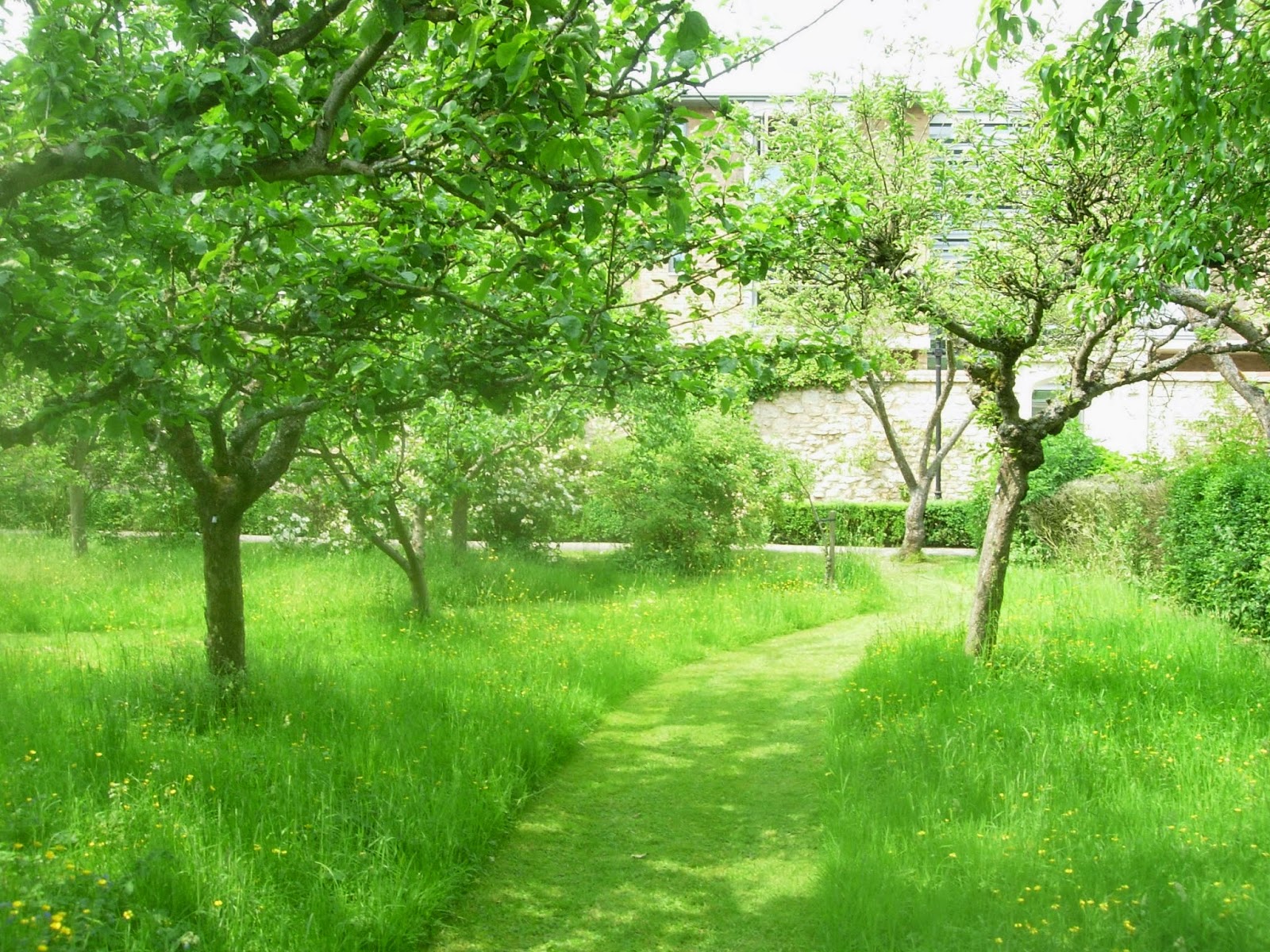
Worcester College incorporates an orchard within its grounds.


Cars are almost entirely banned from the centre of Oxford. This allows streets to be appropriated in the summer for cafes. Park and ride facilities allow motorists to park at the edge of the city and take public transport into the centre.


Bike lanes have been provided throughout the city.


The city’s name refers to its origins as a fording place on a river. The city is sited around the confluence of two rivers, The river Isis  (Thames)  and Cherwell. These, together with the Oxford canal have created ample opportunity to create linear parks.


The Oxford canal on the right with the Isis (Thames) to the left.


The river Cherwell resembles an Indian river in that it seems to have two river beds. Its flood plain creates a linear park in the centre of the city.


Privacy is allowed in the college grounds by the simple device of the railing. This allows views in but prevents straying members of the public wandering in.


An additional   level of privacy is created by the simple device of the wall used to enclose   the famous quadrangles.


Large areas of green land has been preserved quite close to the city centre.  A good example of this would be Christchurch Meadows.


Oxford’s Science Park can be found on the edge of the city. Its presence is signified by a large black building visible from the A4074. Much of its layout follows the familiar pavilions-in-the-park  type theme.  Although such developments have become ubiquitous in Britain in recent decades, the landscape strategy clearly attempts to respond to the specific as opposed to generic qualities of the site. Many of the buildings are orientated towards Littlemore Brook which is provided with a riverside walk.


Most the Science Park’s  streets are  devoid of any pedestrian life.


Extraordinary resources have been lavished in landscaping  car parking spaces.

Although the development has been provided with gymnasium plus café it is doubtful whether this can be really considered to be a mixed-use development.

There has been much discussion over the appropriate form the next wave of British urban development should take. An approach which I think has much potential is that of the retrofit. A business park such as this could be seen as the nucleus of new neighbourhoods as opposed to mono-functional zones. The thinking behind the business park presumably is that the tranquility necessary for work is only possible in buildings separate from city centres, surrounded by countryside. The example of Oxford city centre shows that very private activities such as teaching facilities, libraries and halls of residence can be successfully incorporated into a city centre.

An intellectual like Paul Virilio has often argued that settlement patterns are often determined by transportation patterns. The car-based convenience of the business park can be contrasted with the transport strategy of a historic city such as  Oxford where visitors  usually use park and ride  facilities, leaving their cars on the outskirts of the city to make their journey into the city centre by bus. The challenge to urban designers  is to produce the urban environments of the future where the environment is of such high quality that people will actually be prepared to give up their cars or at least accept a greatly reduced role for them. Perhaps the business people of the future will adopt the practice of Oxford students who often cycle to work.


The expansion of a  city like Oxford might provide an ideal site for growth to solve Britain’s  housing shortage. A site such as Oxford Science park could have  housing developments  built next to them together with some retrofitting of the office buildings into more mixed-use functions.

Another strategic criteria for town expansion is the issue of city size.  The Garden City and  New Town Movements always proposed that cities should only be allowed to reach a certain size and that somewhere between 33,000 to 200,000 was the optimum size for a city. Obviously Oxford would fulfil this criteria. The site is several miles from the city centre, separated by many “green breaks”.

Lancelot  ”Capability”  Brown  acquired his nickname through his habit of telling his clients that their sites had  great “capabilities.” Surely a site like Oxford Science Park has the capability  to provide a starting  point for a mixed-use expansion of Oxford.


( Thanks to Google for aerial view of river Cherwell)